
Who could have seen this coming? Comfortable middle class making money selling rooftop solar back to the grid, cash strapped governments…
Australia Considers a New Household Solar Energy “Export” Tax — Watts Up With That?
Who could have seen this coming? Comfortable middle class making money selling rooftop solar back to the grid, cash strapped governments…
Australia Considers a New Household Solar Energy “Export” Tax — Watts Up With That?
For organisations that want to save on energy costs and increase energy stability but don’t want to commit to full off-grid systems, microgrid solar panel systems offer a cost-effective and powerful solution. Here’s how these systems work to help facilities save, from the specialists in commercial solar panels and energy audits.
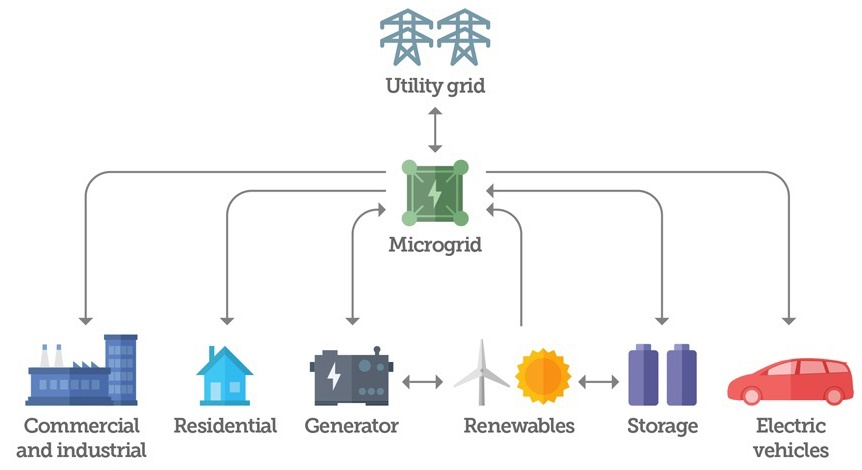
What Are Microgrids?
A microgrid is simply a small-scale energy grid that services a localised area of a few buildings, consisting of an energy production source (in this case commercial solar panels), a network that connects to the existing electrical network, and a storage system of batteries that provides an additional reserve for low solar production days or night-time system use.
Usually, these systems are used as a supplemental energy source, but for small facilities, they can provide for all your energy needs if designed correctly.
The Benefits of Microgrid Commercial Solar Panel Systems
There are several advantages these systems grant to commercial and industrial facilities in addition to the obvious savings that renewable energy offers.
An energy audit will not only reveal opportunities for energy savings, but ensure the system developed for your facility delivers clean, reliable power and delivers returns as promised.
Develop a Solar Microgrid Today with Commercial Solar Panels Systems Specialists
Quality Energy has been in the commercial and industrial energy solutions sector for over 30 years, helping clients find innovative and cost-effective ways of improving power quality and reaching their energy saving goals. As national solar panel services providers and energy audit specialists, we can assist you with every step of developing, implementing and servicing your microgrid solar power system, ensuring it delivers the clean, reliable energy supply you require.
Contact us today for more information on our solar power systems or to schedule an energy audit.

Preliminary survey results from California suggest that long outages are leading people to buy backup generators, possibly instead of rooftop solar. The COVID-19 pandemic has shone a very bright light on the importance of making well-informed tradeoffs. Imagine how comforting it would be if every mayor, governor and national leader had a calculator that told […]
Electricity Outages Lead to Substantial Backup Generator Purchases — Energy Institute Blog

Every owner is very well aware of the dos and don’ts of messing with an electrical panel. Some are aware of what lays beneath the panel which cautions them to use it properly while some are unaware of what lays beneath the panel which cautions them to simple stay away from the panel. Since we are pioneering in the field electrical panels, we would like to impart some basic knowledge to you about your home’s electrical system.
Essential tips on keeping safe from electrical panels at home or in any industry — WeGo Shopping
Regardless of industry sector and size, there’s hardly a business today that doesn’t run off computers and related office equipment. These sensitive and expensive machines form the nerve centre of a business, capturing and managing data, running machinery and equipment, and processing information essential to running your organisation, whether it’s a factory, airport, office building or a hospital. Harmonics, surges and sags in voltage and other power issues that can be revealed in a power quality audit can damage this equipment, cause downtime, and result in data loss. Here’s some insight on how to protect this equipment effectively using power factor correction units and other solutions.
Imperfect Power Quality is Your Reality
It is almost impossible to constantly maintain optimal power quality in a commercial or industrial site. That’s because power quality issues are a constant problem, whether it’s the risk of brownouts or blackouts, or voltage surges and sags from your supply through the grid, or the harmonics and noise that result on your internal electrical network from non-linear loads like uninterruptible power supplies (UPS systems), solar power systems, televisions, servers, and printers.
So, what can a business do to protect computers and essential office equipment? The idea is to discover where the most significant power quality issues lie and address them as part of a holistic approach to energy resilience.
Performing a Power Quality Audit
Because it is very challenging to determine exactly where power quality issues lie in a particular network, a power quality audit is necessary. This will look at your supply as well as key points around your electrical network to determine where issues lie and the best solution to address them in order to optimise power quality as a whole.
Possible causes for poor power quality that a power quality audit will look for include voltage variations (which impact the efficiency of equipment and increases risks of electrical tripping), harmonics (which create stress on the network, causing equipment to work harder to do the same job and using more electricity than they should), and excessive reactive power (which charges wasted power to the system).
Solutions to Improve Power Quality
Power quality solutions exist to tackle these common issues, including:
Active harmonic filters – If non-linear loads are creating significant levels of harmonics on your network, these are an effective solution. Active harmonic filters monitor the current harmonics in the network, injecting the same current in the opposite phase to cancel out the harmonic waves.
Power factor correction units – Power factor correction units can be designed to fit the exact needs of your facility, eliminating penalties from excessive reactive energy and using any excess to supplement your supply when voltage sags. This doesn’t just ensure the safety and efficiency of your office equipment, but also helps reduce overall energy costs.
Voltage stabilisation – Another solution is a voltage stabilisation system, which creates a nominal value voltage output at all times by reducing variations in voltage supplied to your network. This reduces risks of data loss, data security issues and equipment breakdowns.
For more information on power factor correction units, harmonics filtering solutions and more, or to schedule a power quality audit, contact the team at Quality Energy today.

Do you want to install Solar Power Melbourne? If yes, knowing a few crucial things is a must. So read ahead! Proposal Ask companions, family neighbours or associates who have had sun based PV frameworks introduced. Frequently the best purchasing sun oriented tips com from directly in your neighbourhood. They’ll have the option to inform […]
Everything you need to about Solar Power System — Solar Panels Melbourne
Recent trends in the industrial energy sector showcase power factor as one of the biggest issues facing commercial and industrial enterprises today. So, what is power factor? How does power factor correction in Australia work and is it actually worth the investment? Here’s some insight from power quality audit specialists.
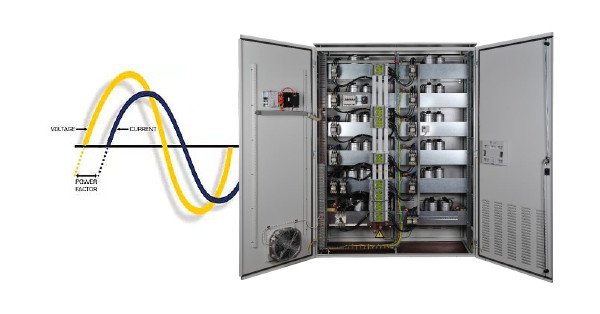
What is Power Factor?
This is the ratio between the energy your facility uses (real power), the power pulled to create magnetic fields (reactive power), and the apparent power (real + reactive power) that is consumed by the AC electrical network. Essentially, it is a ratio that measures how efficiently electrical power is converted into useful output within your facility. The better your power factor (the closer it is to 1), the more efficient it is. The further from 1, the more wastage is occurring. For most facilities, reducing wastage makes a significant, positive impact on operating costs. A power quality audit is the most effective way of determining your facility’s power factor.
How Does Power Factor Correction Work?
First, it is important to note that a power factor of 1 is almost impossible to maintain, simply because there are constant variations in supply and demand, grid instability and many other factors that contribute to a poor power factor. As a result, power factor correction in Australia and around the world aims to get as close to 1 as possible, usually delivering a power factor of 0.8 or higher.
Once a power quality audit has been performed, a power factor correction system can be designed and installed. Leading providers will custom-design your solution to fit your facility’s requirements. This system is at its core a capacitor that acts as a reactive current generator, actively measuring and offsetting non-working power used by inductive loads, and improving the power factor in real time.
This has the effect of lowering energy bills by eliminating utility penalties for poor power factor, reducing power losses and thereby improving energy efficiency, increasing the capacity of the current, improving the voltage supplied to equipment on the network, and protecting equipment from overheating due to voltage oversupply.
Know Your Power Factor – Get a Power Quality Audit Today from Specialists in Power Factor Correction in Australia
For over 30 years, Quality Energy has been providing commercial and industrial clients across Australia with custom, comprehensive power quality solutions. We work with you from the start of your project to completion and beyond, providing power quality audits, custom designing and installing solutions, and maintaining systems after sales. Contact us today to find out more about professional power factor correction in Australia.

How to put your brain on hold and gain awareness
When Did You Last Do an Energy Audit? — Thrive Global
How to put your brain on hold and gain awareness
When Did You Last Do an Energy Audit? — Thrive Global

Check out measures that can help every household save electricity in the home: Use lamps instead of chandeliers – so-called energy-saving light bulbs consume 75% less electricity than ordinary light bulbs. Quality energy-saving light bulbs work for 5,000-15,000 hours. By choosing several smaller light sources, a more beautiful and efficient lighting in the home is […]
Energy-saving light bulbs consume 75% less electricity than ordinary light bulbs — magicandbeauty

 Quality Energy